
Types of Pasta
Pasta is classified as either pasta fresco (fresh)  or pasta secca (dried).
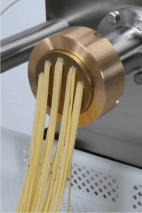 Pasta secca is made from high-protein Durham semolina wheat and has springy texture and a modest amount of starch.  It is especial well suited for chunky tomato sauces and oil-based sauces.  This pasta is extruded or forced through holes in a die-plate and onto sheets for cutting into hundreds of shapes and then dried.

Pasta fresco, is created with a higher a moisture content and is laminated or rolled rather than extruded. Some types only exist in this category. Variations can often be regional. Northern Italy is known to use all-purpose flour and eggs, while southern Italy uses the standard semolina and water mixture. Reputed to have the best pasta fresca in Italy, the Emilia-Romagna region often serves fresh pasta with cream sauces. Another regional variation could be found in Piedmont where butter and black truffles are a common ingredient.
Fresh vs. Dried Pasta –One is not better than the other, but rather the method in which each is made determines quality.  Extruded pastas are used to make many varieties of dried pasta.  Most extruded pastas are made with Durham Semolina and mixed with water.  It is then heated and forced or extruded through various shaped dies to form the different pasta shapes.  The pasta is then dried and packaged.
Laminated or rolled pasta is the process to produce fresh pasta. Â Typically, flour, salt, and eggs are combined to form a dough. Â The dough is then rolled and folded through a pasta sheeter to form flat laminated sheets of dough the may be cut into various pasta shapes.
Commercially dried pastas cook up firmer or more al dente than fresh laminated pasta, which cook up delicate and tender.  Dried pastas are extruded through either teflon dies or brass dies.  Better quality pastas are extruded through brass dies that produce a rougher texture than pasta extruded through teflon dies.  This rougher and more porous surface allows sauce to cling to the pasta better.  Dried pasta that is extruded through a teflon die are smooth, shiny and usually more yellow in color.  Brass die pasta is a paler white with a visibly rougher surface.  Manufacturers often use the teflon dies because the pasta can be extruded much faster than through brass dies and thus lowering production costs.
Fresh laminated pasta also allow the cook the ability to vary the thickness of the past, change the taste of the pasta or make filled pastas like raviolis and tortellini.
 Coucous is a coarsely ground pasta made from semolina wheat. Common to North Africa, couches is a staple of Morocco, Algeria, Israel and the Middle East. Couscous is traditionally made by rubbing the semolina between moistened hands until the flour combines with just enough water to form hundreds of tiny grains. After the couscous grains are formed they are dried and steamed over a stew, usually made from lamb, in a special pot called a couscoussière.  Instant varieties are commonly used today.
 Gnocchi is a dumpling-like pasta made from potato, semolina, or flour.  The are three varieties of gnocchi
- Piedmontese gnocchi, made with potato and flour
- Roman gnocchi, made  with semolina, egg, cheese and flour.
- Parisienne gnocchi made with choux pastry.
 Spätzle is an egg noodle or dumpling found in the cuisines of southern Germany, Austria, Switzerland, Hungary, and Alsace.
For step-by-step instructions on salting the water, testing doneness, and finishing pasta with sauce, see How to Cook Pasta.