Author: Chef Bell

Types of Knives

Chef’s Knife–The chef’s knife is the primary general-utility knife for most western cooks.  A chef’s knife generally has a blade 6 to 14-inches  in length. There are two common types of blade shape in western chef’s knives, French and German. German-style knives are more deeply and …

Spices

Saffron – $2,000 to $10,000 a pound Saffron threads come from the stamens of a crocus, a flower which requires high maintenance. Each flower blooms for one week a year and produces only about three stamens, which must be picked by hand, hence the hefty …

Greek Cuisine


A can of ground cinnamon is shown.Geography

Greece is the southernmost European country in the Balkan Peninsula, and is bordered by Albania, Macedonia, and Bulgaria to the North and Turkey to the East. At 50,000 square miles and about the size of Alabama, Greece is the . About a fifth of the area is composed of more than 1,400 islands in the Aegean, Ionian, and Mediterranean Seas.About four-fifths of Greece is mountainous, including most of the islands.

Oranges, olives, dates, almonds, pomegranates, figs, grapes, tobacco, cotton, and rice abound in the areas of lower elevation, primarily in the East  Among Greece’s main environmental problems are industrial smog and automobile exhaust fumes in the area around the capital, Athens. The smog regularly sends Greeks to the hospital with respiratory and heart complaints.

Landscape and Climate

  • Greek mainland is a peninsula
    • body of land with water on three sides
  • this peninsula sticks out into Mediterranean Sea
  • southern tip is a second peninsula called the Peloponnesus
  • isthmus—narrow strip of land—links Peloponnesus to rest of Greece
  • Greece also includes thousands of islands
  • Mountains cover 70 to 80 percent of Greece, divide land into regions
  • Rugged landscape, lack of large rivers made transportation hard – made it difficult to unite Greece under single government
  • Mild, rainy winters and hot, dry summers – about 50 degrees Fahrenheit in winter, about 80 degrees in summer • Climate encouraged outdoor activities, like athletic competitions

History and Food

Greek cooking traditions date back thousands of years. Greeks today eat some of the same dishes their ancestors did in ancient times. These include dolmades (stuffed grape leaves) and many of the same fruits, vegetables, and grain products. A Greek, Archestratus, is thought to have written the first cookbook in 350 B.C.

The Greek diet has been influenced by traditions from both the East and West. In ancient times, the Persians introduced Middle Eastern foods, such as yogurt, rice, and sweets made from nuts, honey, and sesame seeds. In 197 B.C. , when Rome invaded Greece, the Romans brought with them foods that are typical in Italy today including pasta and sauces. Arab influences have left their mark in the southern part of Greece. Spices such as cumin, cinnamon, allspice, and cloves play a prominent role in the diet of these regions. The Turks later introduced coffee to Greece. Potatoes and tomatoes were brought from New World after exploration of the Americas began about five hundred years ago.

Greek Food

Fresh fruits and vegetables play a large role in the Greek diet. With its long coastline, Greece also relies heavily on fish and seafood. Meat tends to play a less important role. It is often used as an ingredient in vegetable dishes instead of as a main dish. The islands and coastal areas of Greeks favor lighter dishes that feature vegetables or seafood. In contrast, the inland regions use more meat and cheese in their cooking.

Butter Chicken

Membership unlocks the complete recipe.

Shallow Poaching

Shallow Poaching

This technique calls for a small amount of liquid that does not cover the item resulting in food cooked by both steam and liquid. Often the liquid is used in the preparations of the sauce-cuisson as there is a significant amount of flavor transferred between …

Emulsions

An emulsion is the even dispersal of one liquid throughout another immiscible liquid. If the drops of the dispersed liquid are small enough and well separated from each other, the mixture will be thicker than either liquid and will remain in solution, for a time. The amount of time for which the emulsion is stable depends on what is preventing the dispersed phase from coming together or (pooling) and separating from the other liquid.

It is the natural tendency of like molecules to attract each other. If you shake oil and vinegar in a jar it will form what is known as a temporary emulsion. Then the drops of oil in the jar begin to attract each other. As the drops get bigger, they grow faster, incorporating more drops of oil until there is only one very large drop of oil, the upper phase of the jar.

The way to make a more stable emulsion is to physically prevent the drops from getting together. This is accomplished in one of several ways. The use of emulsifiers, finely divided (powdered) solids, polysaccharides, proteins, or even thick liquids, can help stabilize an emulsion.

Emulsifiers have the unique physical property of having two distinctly different areas on one molecule. Each of these areas would prefer to be dissolved in a different substance. This is known as the hydrophilic/lipophilic (water loving/fat or oil loving) balance. Lecithin, which is found in egg yolks, is the primary emulsifier in both mayonnaise and hollandaise. It works because one part of the lecithin molecule attracts the oil or fat and the other part attracts the water and water compatible parts of the emulsion. Finely divided solids or powders such as finely ground-dried herbs can stabilize an emulsion by absorbing oil and water at the interface, (the point where the oil and water meets). Polysaccharides, such as certain gums, can interfere with the pooling process of the dispersed phase or form a matrix that traps the dispersed droplets. Gelatin is an example of a protein that can act as a stabilizer. Proteins that are naturally present in foods can make effective emulsifiers. Another method of stabilizing an emulsion is to add a thick liquid (such as honey) to the two immiscible liquids.

Many flavoring agents are added to emulsified sauces. Some serve only to add flavor. Others, such as vinegars and citrus juices (acids), can also change the physio-chemical properties of the emulsifier. Proteins can be denatured, creating a greater barrier between the dispersed droplets. In the case of mayonnaise and hollandaise, the acid changes the chemical properties of the emulsifier so that it can take up more lipid (fat or oil) before becoming saturated. Plant particulates such as chopped onion and citrus peel are effective in the initial breaking up of droplets when the mixture is whisked or blended. They also act as flavoring ingredients.

There are three main reasons that emulsions separate.

1. Liquid is added too quickly:
When the liquid that is to be dispersed is added too quickly, the emulsion may never form or may quickly separate. This occurs because there is not sufficient time for the liquid to disperse fully. The tiny drops cannot form, and pools of the liquid are created instead. There are two solutions for this problem. One is to slowdown the stream of liquid, giving it time to disperse into the continuous phase. The second is to mix the item faster.

2. The mixture becomes saturated:
When an emulsified mixture becomes saturated, it is similar to when the liquid is added too quickly. The difference is that no amount of whisking will incorporate all of the liquid. With saturation, there is simply too much oil. A towel can only hold a certain amount of water without dripping. When it becomes totally saturated with water, it begins to release some. This is what happens in an emulsion when too much of the liquid to be dispersed is added.

When saturation occurs, the solution is to put some of the continuous ingredient into a separate mixing bowl and slowly add the broken emulsion into it. When the emulsified mixture nears saturation it is easier to break it by over- whisking. Adding a small amount of acid (lemon juice, for example) can increase the saturation point of the mixture.

3. Temperature:

Temperature abuse is a major cause of broken emulsions. In the kitchen, the most common emulsion is between oil or fat and a water based solution (vinegars, fruit juices, wines, stock, etc.). Often the emulsifier is a protein or is part of a protein system. Proteins are relatively large molecules that exist in their native state folded in a certain configuration. When the protein is exposed to heat, acid, or agitation, it can be unfolded. This unfolding (a change in shape) is called denaturation. Excessive heat, agitation, or acid can catalyze chemical reactions that can destroy the protein molecule’s emulsifying properties.

The thickness of the liquids being emulsified is affected by temperature. When oil gets cold, it gets thick. When it gets hot, it becomes thin. Water does not do this to any noticeable extent. This presents a problem in making an emulsion because, not only are you trying to combine two immiscible substances, you are often trying to mix two solutions that are of different thickness. If you are trying to make a mayonnaise in a very cold room, you encounter the problem of trying to incorporate a thick oil into a relatively thin egg mixture. When this happens, the oil molecules tend to clump together. If the oil clumps together, it will not be able to disperse effectively. Butter sauces are emulsions that are formed using the proteins and natural emulsifiers found in fresh whole butter (strengthened by acid in wine or citrus juice). This emulsion is very temperature dependent in that, if it is allowed to cool and is reheated, it will break.

Cuttlefish

Cuttlefish

Cuttlefish, often mistaken for calamari or squid, has its own characteristics. The cuttlefish, with its shorter tentacles and relatively large, wide body, is also distinguished by the “cuttlebone (calcified cartilage, which is often given to caged birds). It has more flavor than its cousins and …

Polenta

Polenta

Polenta has similarities to the hominy grits that are popular in the Southern United States. In this way polenta, grits and other “mush” type foods share a common link as the food of poverty. However in ancient times, what would later be called polenta started …

Porcini Mushrooms

Porcini Mushrooms

Porcini belong to the Boletus genus of mushrooms, characterized by a soft, meaty white body that does not change color after it is cut (Boletus that change colors to blue when cut or bruised should not be eaten. Porcini grow in association of specific trees and are considered mycorrihzal associates – in effect, Porcini live in a symbiotic relationship with the trees they grow under. Many mushroom foragers find Porcini living under pine trees, poking up through the dead needles, but it is considered by many that the best Porcini are picked in chestnut woods. These Porcini are known for a light-colored hat and are the best eaten fresh. As the Porcini gets older, its underhat turns a darker color. All species of Porcini are characterized by a big, round, fleshy cap that is supported by a short round stalk.

            There are several different types and qualities of porcini mushrooms. Boletus Edulis or Porcino D’ Autunno (Autumn Porcino) is one of the most sought after Boletus species in the world. Referred to as the “King”, this Porcino (called Cep in France) is found in North America, Europe, and Asia. Fresh Porcini of this species are sought after my mushroom hunters the world over and have recently started being exported out of Russia where they are known as Belyi Grib. Boletus Brisa is an Italian variety that grows mainly in the Apennines near Parma and in other mountain areas. Porcini with dark hats known as Porcino Nero grow in stands of beech or fir trees and are more suitable to be preserved, but are less tasty. Porcino d’ estate or Boletus Reticulates is found in the summer near evergreens while Porcino del Freddo are found in the colder areas.

            Gathering wild Porcini is still the preferred way of getting fresh mushrooms but is not suggested unless you are properly trained. California and New Mexico in the US are major hotspots for Porcini gathering, with large harvests available in the pine forests and mountain areas. In Italy Porcini are almost too popular, with gathering strictly regulated as Boletus is becoming endangered from over-harvesting. A permit is required and a strict quota of two kilos per week is enforced. Porcini harvesters in Italy are also required to gather the mushrooms in open baskets to let spores escape and ensure the survival of the mushroom.

            When buying fresh Porcini, carefully examine the mushroom for signs of age. If the undersides of the caps have a yellowish-brown tinge to them, the mushrooms are becoming over-ripe. Do not buy a Porcino if is has a dark under-cap or black spots on it. Also look out for tiny holes in the stem, which is a sign of worms. If you do notice some signs of worms after purchasing them, stand the Porcini on their caps for a time to allow the worms (they are harmless) to escape out of the stalk. Brush off any dirt you may find and wipe the mushrooms clean with a damp cloth. You can wash them in cold water if you want, but only if you plan to use them right away.

            In Italy fresh Porcini mushrooms are preferred grilled and served with fresh olive oil and parsley.

            In Italy the Porcini that are not ideal for eating fresh are often jarred or canned in olive oil. The Porcino Nero, with its dark cap as well as other Porcini that grow under fir trees make the most likely candidate for preserving. The oil preservation seems to make these lesser Porcini much tastier than if they were used fresh and are extremely versatile, replacing both fresh or dried in recipes. When looking for Porcini mushrooms jarred in oil choose extra virgin olive oil and make sure the jar was not exposed to too much light. You may find local Boletus species preserved in oil and they are most likely very good, but may have a different flavor than Italian Porcini due to the huge variety in the Boletus genus and growing conditions.

            Dried Porcini is how most consumers see these mushrooms in the supermarkets. Dried Porcini have a concentrated flavor and mushroom aroma that is excellent in Risotto, soups, and some amazing sauces. To prepare dried Porcini steep them in boiling water to cover until they are reconstituted. After draining the Porcini mince, them but keep the steeping liquid. This liquid adds even more concentrated Porcini flavor to the recipe, just make sure you strain it first. When buying dried Porcini look them over carefully. A bag of old, crumbly pieces and dust will be worthless. A strong mushroom aroma should greet you once opening the package, if the mushrooms have no smell, then they have no flavor either. Like fresh Porcini, look over the package for signs of worms and do not buy them if there are pinholes in the mushrooms. Dried Porcini should not be neglected, they may not be as versatile as fresh mushrooms, but their flavors have been concentrated to a point where they can really make a difference when going for that authentic flavor.

Capers

Capers

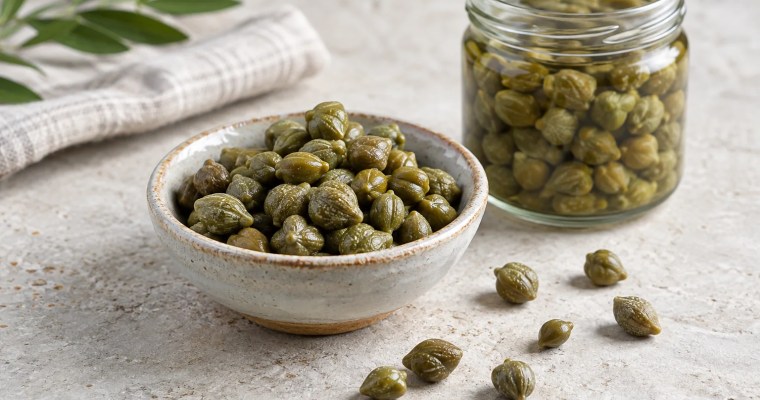
Capers are the unopened green flower buds of the Capparis spinosa (Capparidaceae – caper family – closely related to the cabbage family), a wild and cultivated bush that is grown mainly in Mediterranean countries (southern France, Italy, and Algeria) and also in California. Manual labor …