
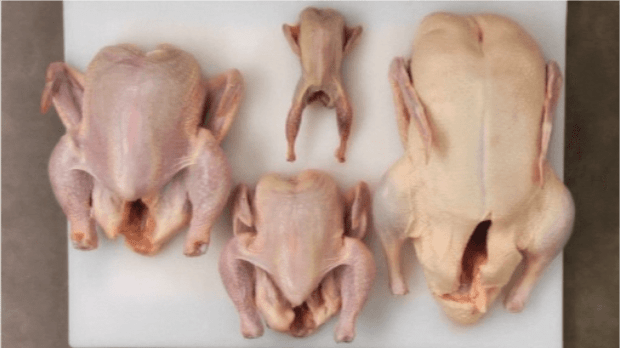
The term Poultry refers to domesticated birds raised for their meat and/or eggs.  The USDA classifies poultry into these six categories: Chicken, Duck, Goose, Guinea, Pigeon, and Turkey.  Each of these categories are further defined by how tender their meat based on the bird’s age.  Younger birds are more tender than older birds.  Birds such as pheasants, quail and partridge are classified as Game Birds.  Ostriches, emus and rheas are known as Farm-Raised Ratites.
|
USDA CHICKEN CLASSES |
||||
| CLASS | DESCRIPTION | AGE | WEIGHT | COOKING METHOD |
| Game Hen | Cornish Chickens | 5-6 weeks | 2 lbs. or less | broil, grill |
| Broiler/Fryer | Young, tender | 13 weeks | 3 ½ lbs. or less | any |
| Roaster | Young, tender | 3-5 months | 3 ½ – 5 lbs. | any |
| Capon | Castrated male | Under 8 months | 6-10 lbs. | roast |
| Hen/Stewing | Mature female, flavorful but less tender | Over 10 months | 2 ½ -8 lbs. | stew, braise |
[divider style=”4″]Marketing Terms:
“Free Range”
There’s no precise federal government definition of “free range,†so the U.S. Department of Agriculture (USDA) approves these label claims on a case-by-case basis. USDA generally permits the term to be used if chickens have access to the outdoors for at least some part of the day, whether the chickens choose to go outside or not. In practice, most chickens stay close to water and feed, which is usually located within the chicken house. Chicken labeled as “organic†must also be “free-range,†but not all “free-range†chicken is also “organic.†Less than 1% of chickens nationwide are raised as “free range,†according to the National Chicken Council (NCC).
“Natural”
Under USDA regulations, a “natural†product has no artificial ingredients, coloring ingredients, or chemical preservatives, and is minimally processed, just enough to get it ready to be cooked. Most ready-to-cook chicken can be labeled “natural,†if processors choose to do so.
“Organic”
The USDA has a very specific rule to define “organic†production and prohibits the use of the term “organic†on packaging of any food product not produced in accordance with its rule. According to USDA, the organic label does not indicate that the product has safety, quality or nutritional attributes that are any higher than conventionally raised product.
“No Hormones Added”
No artificial or added hormones are used in the production of any poultry in the United States. Regulations of the Food & Drug Administration prohibit the use of such hormones. No such hormones are used. So any brand of chicken can be labeled “Hormone-Freeâ€. However, any package of chicken with that type of label must also have a statement that no hormones are used in the production of any poultry.
“Raised without Antibioticsâ€
“Raised without Antibiotics†on a package of chicken indicates that the flock was raised without the use of products classified as antibiotics for animal health maintenance, disease prevention or treatment of disease. Animal health products not classified as antibiotics (such as some coccidiostats, which control protozoal parasites) may still be used. “Antibiotic free†is not allowed to be used on a label but may be found in marketing materials not regulated by the U.S. Department of Agriculture. It means the same thing as “Raised without Antibiotics.†All chicken is “antibiotic-free†in the sense that no antibiotic residues are present in the meat due to the withdrawal periods and other precautions required by the government and observed by the chicken companies
Enhanced Chicken Products
Some fresh (raw and uncooked) chicken products are enhanced with chicken broth or a similar solution. The presence and percentage of the broth or other solution must be stated clearly and the actual ingredients listed on the label. Both enhanced and non-enhanced products are currently available in the marketplace.
Sodium is used in the broth or solution of some enhanced products, usually at very low levels. The presence of salt or sodium is noted on the label.
“Retained Waterâ€
A “retained water†statement, such as “May contain up to 6% retained water†or “Less than 4% retained water,†is often found on packages of fresh poultry. USDA prohibits retention of moisture in meat and poultry except for the amount that results from essential safety procedures, such as chilling processed chickens in ice-cold water to reduce their temperature and retard the growth of spoilage bacteria and other microorganisms. If any moisture is retained by the product after this procedure, it must be stated on the label.
“All-Vegetable Diet”
Poultry feed is made primarily from corn and soybean meal. Poultry feed sometimes includes some processed protein and fats and oils from meat and poultry by-products. The composition of all animal feed ingredients used in the United States is regulated by the Association of American Feed Control Officials (AAFCO). If the chicken company chooses not to use these ingredients, the feed would contain no ingredients derived from animals and could be described as “all vegetable.â€
White Meat and Dark Meat

The difference between white meat and dark meat is the amount of myoglobin present in the muscles. Â Myoglobin is a protein that carries oxygen to the muscles. Â Working muscles, like those that support flight in the breast, require an abundance of myoglobin. Â Since chickens and turkey rarely (if ever) fly, their breast muscles have little myoglobin compared to birds that fly like, ducks. Â As a consequence of the lower amounts of myoglobin, the breast meat of turkey and chicken is white while duck breast meat is dark red. Â Wild turkeys, that do fly occasionally, have darker breast meat.
Dark meat also differs from white meat in the amount of connective tissue. Â Working muscles, like those in the legs necessarily have a lot of connective tissue. Â An abundance of connective tissue makes meat tough. Â White meat has little connective tissue and is comparatively more tender than dark meat. Â Dark meat, while tougher and requiring more cooking time, is also considered more flavorful and juicer when properly cooked. Â Dark meat should be cooked to 175ËšF to 185ËšF.

Breast Meat
The breast in poultry has two lobes and the tender.  Breast meat is white in turkey and chicken and dark in duck.  Breasts may be fabricated with or without skin or bone.  Half a breast with attached wing joint, often frenched, is known as  a suprême or airline breast.  A suprême with the skin removed is referred to as a côtelette.
Cooking Breast Meat-Breast meat varies in thickness and may be sliced and/or pounded to even out the thickness.  The mild flavor of breast meat benefits from brining and marinating.  Leaving the skin and bone on adds flavor and helps to keep the meat moist.  Poaching, steaming and most dry heat methods are best for cooking breast meat.  Long braising or stewing is the least suitable for white meat.  If white meat is desired for a soup or stew, cook the meat separately and add it in to the soup or stew at the end of cooking.  White breast meat of chicken or turkey should be cooked to 165ËšF.  Duck or pheasant breast should be cooked to no more than 130ËšF to 135ËšF. Â
AÂ 4 oz. portion of boneless, skinless chicken breast has 140 calories, 4 grams of fat and 25 grams of protein or 50% the recommended amount of protein for an average adult.


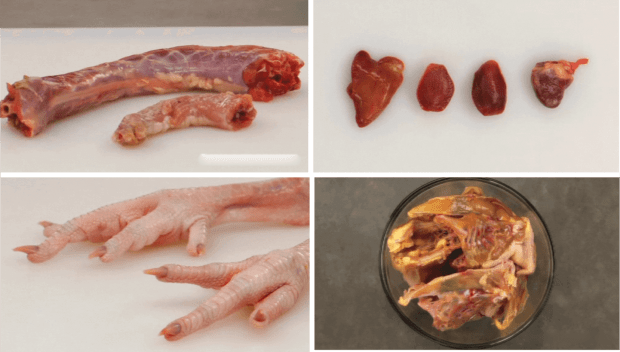
Innards
Nutrition: Chicken vs. Beef
Fat and Cholesterol-Chicken has about the same amount of cholesterol but 1/3 less saturated fat than beef. Â A 3-oz. serving of beef provides 76 mg of cholesterol and 2.9 g of saturated fat. A 3-oz. serving of chicken provides 73 mg of cholesterol and 0.9 mg of saturated fat.
Calories-Chicken has somewhat less calories than beef, but the difference is not significant. Â A serving of chicken provides 142 calories, and a serving of beef provides 173 calories.
You must be logged in to post a comment.