
The word “steak” refers a cut of meat, usually beef, cut perpendicular to the muscle fibers, or in the case of fish, perpendicular to the spine.  Steaks from pork or lamb are referred to as “chops”. For beef, many different cuts are referred to as steaks and may come from the chuck, rib, short loin, sirloin, plate and flank primals. The premium steaks featured in restaurants come mostly from the rib and short loin and have an abundance of intramuscular fat or marbling.Â
Grading
In the US, all meat and poultry are required to be inspected for wholesomeness by the United States Department of Agriculture.  After meat and poultry are inspected for wholesomeness, producers and processors may request that their products be graded for quality by a USDA licensed Federal grader. Those who request grading must pay for the service. Grading for quality means the evaluation of traits related to tenderness, juiciness, and flavor of meat.  The age of the animal and the marbling of the meat determine the grade of the meat. In the United States, retail grades are prime, choice and select, with prime being at the top and select being the bottom. The lower rated meats may be sold retail as ungraded or store-brand cuts of meat.  The lowest rated cuts not for general retail distribution and are used in processed foods and canned meat products.

Prime grade beef makes up about 2% of all the beef produced in the United States and typically ends up exported or sold to fine restaurants and hotels.  It is produced from young, well-fed beef cattle and has abundant marbling.  Prime roasts and steaks are excellent for dry-heat cooking  methods like broiling, roasting, or grilling.

Choice beef is widely available  in supermarkets and restaurants. This beef has a good amount of fat marbling, although less than U.S. Prime. U.S. Choice accounts for roughly 50% of all graded beef. This beef can typically be cooked with either dry or moist heat methods without causing excessive dryness.

Select is very uniform in quality and normally leaner than the higher grades. It is fairly tender, but, because it has less marbling, it may lack some of the juiciness and flavor of the higher grades. Only the tender cuts (loin, rib, sirloin) should be cooked with dry heat. Other cuts should be marinated before cooking or braised to obtain maximum tenderness and flavor.
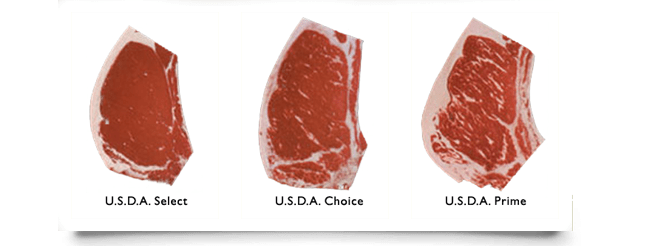
Marbling is an important factor in steak selection. Marbling should be thin streaks of fat within the muscle. Thick lines of fat mean the steak contains a lot of connective tissue that will make it tough. The meat should be bright red and the fat, a creamy white, evenly distributed throughout the meat.

Aging
Steak from a freshly slaughtered cow is stringy and tough. For this reason, beef is aged, a process that tenderizes it and enriches the flavor. Traditionally, beef was dry aged, where it was hung in a cold room and its natural enzymes would break down the muscle fibers. The beef loses weight to evaporation, and the moldy crust that develops on the exterior has to be lopped off, lowering the yield and increasing cost. In the 1970s, industrial meat processors introduced wet aging, where sub-primal cuts of beef are aged sealed in cellophane.  The process can be a shorter process than dry aging with a no yield loss due to dehydration. Dry-aged beef has an intense beefy flavor, with a somewhat roasted or nutty flavor.  Wet-aged beef can taste slightly of iron and has a much more mild flavor.

Short Loin
The short loin is the portion of beef immediately behind the rib.  It is the dividing point between forequarter and hindquarter when the carcass is halved into sides and then quartered.  The short loin has a single rib, the 13th rib and a part of the backbone.  The short loin contains the tenderloin, which can be removed and portioned into steaks or roasts.  The short loin with the tenderloin removed is called the strip loin.  The strip loin yields strip steaks or boneless New York Strips or bone-in Kansas City Strip Steaks.  Strip steaks are known as club steaks internationally. Porterhouse and T-Bones steaks are cut from the short loin when the tenderloin is left attached.

T-Bone and Porterhouse
The T-bone and porterhouse are essentially the same steak. Both steaks are made up of two smaller steaks, the strip steak and the tenderloin divided by the t-shaped bone. Porterhouse steaks are cut from the rear end of the short loin and have more tenderloin steak, along with (on the other side of the bone) a large strip steak. T-bone steaks are cut closer to the front, and contain a smaller section of tenderloin.  The first steak cut from the rib end of the short loin will have little or no tenderloin.  This is essentially a strip steak but may also be referred to as a club steak, Delmonico steak or shell steak.  Loin steaks are tender to very tender and have a low to modest amount of beef flavor.  Loin steaks are best cooked with dry heat.Â
Porterhouse steaks are often considered the most premium of the loin steaks due to their size. Â Arguably, the t-bone is the superior steak because the porterhouse has the most amount of nerve fibers running through the strip side and a large piece of tenderloin, which, while very tender, doesn’t have much flavor.

Tenderloin
The tenderloin refers to the two elongated muscles run along each side of the spine and  spans the short loin and the part of the sirloin.  The butt end or butt tender is the thickest end in the sirloin.  The tapered end or tail extends into the short loin.  This muscle does very little work and as a result, is the most tender cuts of beef.  It also has a very mild beef flavor and benefits from flavor enhancements like rubs and marinades.  Since the tenderloin is already very tender, care must be taken when marinating a tenderloin that it isn’t over tenderized and turned mealy.
The tenderloin may be cut into roasts and steaks.  Filet mignons are classically 1-2 inch thick steaks cut from the tail end of the tenderloin.  Tournedos are thinner steaks cut from wider portions of the tenderloin.  Today, the terms filet mignons, tournedos and medallions may refer to any steak cut from the tenderloin. The Chateaubriand is a small roast (for two) cut from the center of the tenderloin.


Rib
The  rib primal is derived from a forequarter and is between the chuck primal and a short loin primal.  The rib primal is cut between ribs 6 – 12.  The ribeye muscle is located near the center of the rib primal cut.  Because these muscles are used infrequently, ribeye meat is more tender and contains more marbling.
Not to be confused with the meat grade of “prime”, the prime rib cut constitutes the majority of a rib primal.  The prime rib may be roasted as is or the ribeye muscle is removed from the bone and then cut into thick ribeye roasts and/or thinner ribeye steaks.  The remaining large beef ribs are popularly used in barbecue.  (These are not short ribs, which are derived from the plate primal.  The prime rib is further divided into first cut and second cut.  The first cut refers to ribs 9-12 and is the most preferred.  The second cut refers to ribs 6-8, closer to the shoulder.  The bones of the second cut are larger and the muscle structure more irregular.

You must be logged in to post a comment.