
Braising specifically refers to the cooking of portion-sized or larger, tough cuts of meat in enough liquid to partially cover them. The large cuts include roasts used in braises like pot roast. Individual portion cuts include items like short ribs, lamb shanks, and pork chops. The tougher cuts of meat benefit the most by the long-slow cooking of a braise. Large working muscles like the shoulder have an abundance of flavor and an abundance of connective tissue. This connective tissue, made up of collagen fibers, is what makes meat tough.  As meat cooks, it begins to lose moisture around 140˚F, when meat reaches 160˚F, the collagen begins to melt and turn into a rich liquid gelatin.  It is this gelatin that gives a braise (or a soup, stew or sauce) its rich and silky mouthfeel. Meat is often larded (larder in French) with thin strips of fatback to keep it from drying out during this long cooking process.
The challenge in braising is to dissolve as much of the meats connective tissue without losing too much moisture in the process.
Whole birds and tougher cuts of poultry like the legs and thighs can also benefit from being braised or stewed. Traditionally, only mature poultry were used in a braise as the younger birds lacked the flavor and texture to stand up to long cooking times.  The classic French Coq au Vin refers to an old rooster stewed in wine.  Firm-fleshed fish or seafood, vegetables and tender cuts of meat may also be braised, but it is more about flavor development than it is about tenderizing the item.
Stewing is essentially the same as braising except that the food is cut into bite-sized even pieces, and is cooked in enough liquid to cover the items.  In both braising and stewing, the food may be browned before the liquid is added, and a mirepoix of roughly cut vegetables is often included for flavoring.  When mirepoix is used, it generally won’t caramelize much due to the high moisture content of the vegetables, particularly the celery. Traditionally, the pot is tightly covered so that the food cooks slowly in the liquid and steams until very tender. The resulting liquid is exceptionally flavorsome and is served as an integral part of the stew or as a sauce for the braise. Braises often add the extra step of reducing or thickening the braising liquid to produce a sauce for the braised item.  Tightly covering the braising/stewing pot will increase its cooking temperature and may allow the liquid to boil and resulting in a rapid loss of moisture in the meat.  Cooking at lower temperatures, 250ËšF or less and leaving the lid askew will help prevent the meat from drying out; if cooked too fast, the meat will be dry and stringy.
When braising or stewing meats, the meat is cooked until fork-tender.
The difference between roasting and braising/stewing is how heat is transferred to the food.  Roasts cook in hot air and braises and stews cook mostly in liquid.  The liquid in a braise or stew conducts heat much better than air. Meat roasted at low temperatures never reaches a temperature sufficient to melt the collagen before the meat loses it moisture and dries out.  Boiling or steaming the meat would work but wouldn’t yield a flavorful sauce in the process or the caramelized exterior produced by searing.
Searing–As in the first stage of sautéing, a braised and stewed dish usually begins with browning  or searing the food to achieve a deep, rich color and develop a savory flavor.  To properly sear, the pan must be hot with a thin film of shimmering oil that’s almost smoking.  It is also very important that the items to be seared are dry and that the pan isn’t overcrowded.  Along with monitoring the caramelization of the item being seared, monitor the development of the sucs in the bottom of the pan.
White meats such as veal and poultry are seared just long enough to slightly stiffen or sieze the meat. Â For white stews or braises, the meats may be seared briefly with no color, blanched or not seared at all.
Braising and Stewing Vegetables
A vegetable braise or stew may be one ingredient like fennel or Belgian endive or a combination of several vegetables like ratatouille. Â The vegetable braise or stew will usually include aromatic vegetables also like shallots or a mirepoix.
The amount of liquid used varies with the type of vegetable being cooked. Â Some vegetables do not release a significant amount of liquid and will need additional liquid such as stock, wine, fumet, juice, or water.
For non-vegetarian dishes, a pork product may be added as a cooking fat and to add additional flavor.
Keys to Braises and Stews
- For stews, ideally cut the meat into 1 1/2-inch cubes and  no smaller than 1-inch cubes.
- For braises, keep the meat intact and tie or truss it to hold its shape.
- Dry the meat with paper towels. Season liberally with salt. Allow to rest at room temperature for at least 40 minutes and up to 2 hours. Alternatively, place on a plate or on a rack over a baking sheet in the refrigerator overnight. Remove from refrigerator at least 40 minutes before cooking.
- Sear the meat quickly in hot fat and avoid cooking the interior of the meat. Â Smaller cuts of meat may be dredged in flour for quicker browning, Â The flour will also thicken the braising or stewing liquid.
- Choose an appropriate-sized pan just large enough to hold the ingredients and to keep to a minimum the amount of liquid needed to submerge or partially submerge the ingredients.
- In braising, use just enough liquid to cover the ingredients by one-third to two-thirds. Adding excess liquid will only the flavor of the final sauce.
- Start the pot in a COLD oven with the lid slightly ajar to allow some evaporation. (In conventional braising and stewing the pot is sealed with a tight-fitting lid.)
- Set the oven temperature to 200˚F and allow the braise/stew to slowly warm to 120˚F over two hours. (In conventional braising and stewing, the pot is brought to a simmer on the stove top before going into a hotter, 300˚F or more oven.)
- Raise the oven temperature to 250ËšF so that the stew slowly warms from 120ËšF to 180ËšF.
- After an hour, check the meat every half hour until the meat is fork-tender.
- Allow the meat to cool in the liquid so that it will reabsorb some liquid.
- Remove the meat and reduce the liquid or thicken it to the desired consistency and flavor.
Braising Pans
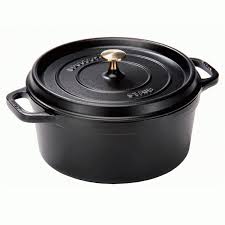
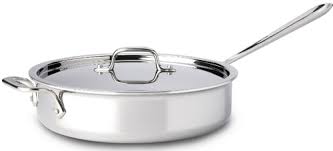
Braising pans should be deep, wide, and heavy-bottomed with a lid to fitted with an aluminum foil cover.

You must be logged in to post a comment.