
The word “salad” is derived from the Latin salata which means salty, from the Ancient Roman practice of eating seasoned vegetables with salt and vinegar.  A salad may be composed of an endless variety of herbs or meat, poultry, game, or fish, grains, pastas, legumes, and vegetables and grains, or pasta in an almost infinite variety of combinations. Salad ingredients may be raw raw or partially cooked, served hot or cold and and are usually dressed and seasoned.  Salads are often served with a dressing that may be sweet or savory.
We associate salads with lettuce but many salads do not contain lettuce. Salads may be served as an appetizer, a main course, a separate course, a side salad, or dessert, depending on which ingredients are used. Â In Europe, salads served after the main course are meant to refresh and cleanse the palate. Serving the salad after the main course may also avoid mismatches with a wine served with the meal and any vinegar in the salad’s dressing. It is also commonly believed that eating the salad after the main course is better for the digestion.
Types of salads
Green salad
The “green salad” or “garden salad” is most often composed of leafy vegetables such as lettuce varieties,spinach, or rocket (arugula). Due to their low caloric density, green salads are considered a common diet food. The salad leaves may be cut or torn into bite-sized fragments and tossed together (called a tossed salad), or may be placed in a predetermined arrangement (a composed salad).
Vegetable salad
Vegetables other than greens may be used in a salad. Common raw vegetables used in a salad includecucumbers, peppers, tomatoes, onions, spring onions, red onions, carrots, celery, and radishes. Other ingredients, such as mushrooms, avocado, olives, hard boiled egg, artichoke hearts, heart of palm, roasted red bell peppers, green beans, croutons, cheeses, meat (e.g. bacon, chicken), or seafood (e.g. tuna, shrimp), are sometimes added to salads.
Bound salad
American-style potato salad with egg and mayonnaise
A “bound” salad can be composed (arranged) or tossed (put in a bowl and mixed with a thick dressing). They are assembled with thick sauces such as mayonnaise. One portion of a true bound salad will hold its shape when placed on a plate with an ice-cream scoop. Examples of bound salad include tuna salad, pasta salad, chicken salad, egg salad, and potato salad.
Bound salads are often used as sandwich fillings. They are popular at picnics and barbecues, because they can be made ahead of time and refrigerated.
Main course salads
Main course salads (also known as “dinner salads” and commonly known as “entrée salads” in North America) may contain grilled or fried chicken pieces, seafood such as grilled or fried shrimp or a fish steak such as tuna,mahi-mahi, or salmon or sliced steak, such as sirloin or skirt. Caesar salad, Chef salad, Cobb salad, Greek salad, and Michigan salad are dinner salads.
Fruit salads
Fruit salads are made of fruit, and include the fruit cocktail that can be made fresh or from canned fruit.
Although tomatoes are considered fruits, and commonly included in salads, they are not normally an ingredient in Fruit Salad.
Dessert salads
Dessert salads rarely include leafy greens and are often sweet. Common variants are made with gelatin or whipped cream; e.g. jello salad, pistachio salad, and ambrosia. Other forms of dessert salads include snickers salad, glorified rice, and cookie salad popular in parts of the Midwestern United States.
Washing and Preparing Greens
 Salad greens should be stored in their original condition and prepped the day of service. Â Do not cut or wash to far in advance. Â With clean hands, rinse the the greens in cold water. Â Greens that are somewhat soft may be refreshed by soaking in ice water. Â Dry the greens throughly using salad spinner. Ready-to-eat, pre-washed greens do not have to be washed.
Greens should be torn by hand, especially tender lettuces like Boston bibb. Â Hand torn leaves look better and stay firmer longer. Â Firmer lettuces like romaine and iceberg can be cut with a knife. Â Remove any tough ribs and stems from lettuces like romaine.
Salad Greens
 Iceberg
 Iceberg
Iceberg lettuce is by-far, the most common salad greens. It is round, compact, pale-green and is generally the mildest of the lettuces.  Iceberg lettuce is valued more for its crunchy texture than for its flavor and often mixed with other salad greens.  It is typically eaten cold and raw in salads, sandwiches, hamburgers, tacos, and in many other dishes.
 Romaine
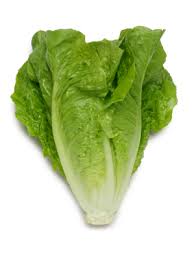 Romaine
This large leafy lettuce is stiffer than most; a thick center rib gives it a real crunch. The thicker part of the rib can give this lettuce a slight bitter taste and may be removed for more refined presentations. This is the lettuce associated with the Caesar salad.
 Boston or Bibb
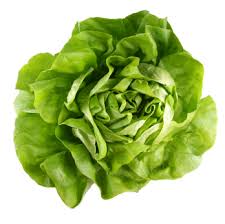 Boston or Bibb
A type of head lettuce, the leaves of Boston and bibb lettuces are soft. And as this variety’s name implies, the texture of a butter lettuce is indeed smooth like butter. Bibb is the more expensive of the two and is usually sold in a plastic container to protect the delicate leaves.
 Arugula
 Arugula
Peppery and piquant, arugula brings on a bold, slightly bitter taste reminiscent of mustard seed, chili spice and peppercorns that cuts through richer foods and flavors. Tender to the touch and taste, fresh arugula leaves are firm, with an “al denteâ€-like chew.
Alternate Names:Â Rocket, Italian cress, Mediterranean rocket, rugola, rugula, roquette, rucola

Frisée
Frisée has curly leaves tinged with yellow and green are slightly bitter in taste, a crunchy stem, and add a lot of texture. Their pale green, white, and yellow coloring is a result of being covered (cloched) during the growing process. Frisée is closely related to escarole.
Alternate Names:Â Curly endive, chicory, chicory endive, curly chicory
 Endive
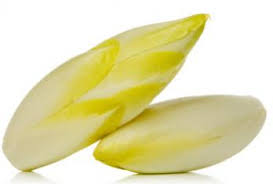 Endive
Endive is oval in shape, with a soft satiny texture, and slightly bitter in taste. It’s white, and yellow coloring is a result of being covered (cloched) during the growing process.
Alternate names:Â Belgian endive, French endive, witloof, witloof chicory, Belgium chicory

Radicchio
 Radicchio
Pronounced “rah-dick-ee-yo.” radicchio comes  as a compact round head, or shaped like its relative, endive. When cooked, the red-purple hue turns brown and what was once bitter becomes sweet.
Alternate names:Â Chioggia, red chicory, red leaf chicory, red Italian chicory
 Mizuna
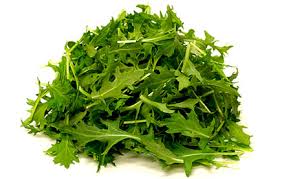 Mizuna
This Japanese mustard green has a relatively strong pungent flavor when compared to other salad greens. The small jagged edges that make mizuna look like miniature oak leaves add a lot of texture.
Alternate names: Japanese greens, spider mustard, xue cai, kyona, potherb mustard, and California Peppergrass
  Escarole
 Escarole
Related to frisée, this mildly bitter leafy green is large and crisp. Escarole is often used in soups and paired with beans, reflecting its popularity in Italian cuisine.
Alternate names:Â Batavian endive, scarole, broad-leaved endive
Baby beet greens
When the leaves of the beet top are immature, they are tender and slightly spicy. When wilted, the veins become brighter in color and a little bit sweeter.
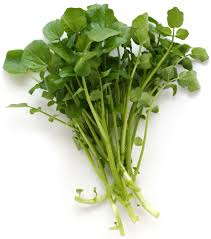 Watercress
Watercress, the a popular type of cress. Other varieties include upland cress, curly cress, and land cress. A peppery taste is characteristic of all varieties. Sold in bunches, watercress has a tough, fibrous stem and small green leaves.
 Tatsoi
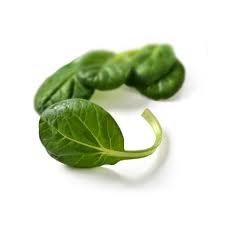 Tatsoi
The small, rounded leaves of this Asian salad green have a mild, mustard-like flavor. The texture is similar to that of baby spinach, and one can be swapped for the other. Baby tatsoi is usually sold loose, but when mature, tatsoi can be purchased whole, in the shape of a rosette, and it is often cooked intact in Chinese stir-fries.
Alternate names:Â Tat soi, spoon cabbage, rosette bok choy
 Mâche
Mâche
 Mâche
MâcheMâche imparts a mild and slightly sweet flavor to a salad. Because of the small size of the leaves, trying to create a salad with a base of mâhe can be expensive. Its leaves are also very delicate and will bruise easily, so handle with care.
Alternate names:Â Field salad, lamb’s lettuce, corn salad, field lettuce
Green Leaf  and Red Leaf

 Green Leaf  and Red Leaf
Leaf lettuce has a mild flavor and are very pliable, despite the crunchy stem. Their uneven ruffled surfaces add layers of texture to salads. Because the leaves are so large, it’s best to tear them up into bite-size pieces.Â
Alternate names:Â Leaf lettuce